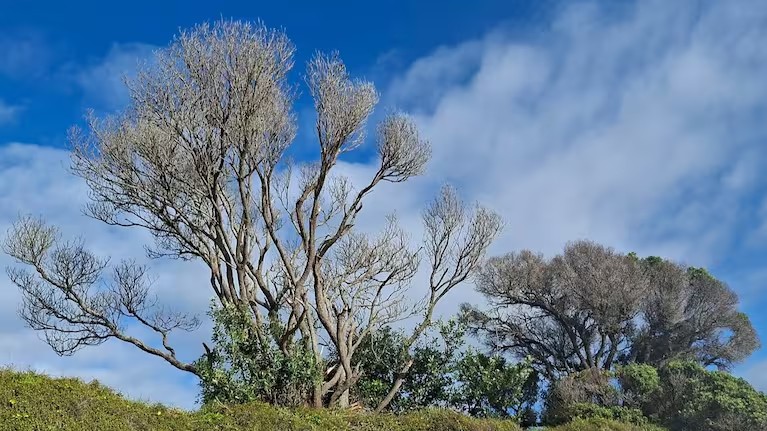
The Department of Conservation is investigating after two pohutukawa trees beside Hahei Beach on the Coromandel were found with signs of illegal poisoning, in a case that turns a local beach incident into a wider reminder about coastal protection.
1News reported on 28 July that the trees are located on the Hahei Beach Marginal Strip and had clear evidence of drill-and-fill holes around their bases. DOC said the damage amounted to illegal poisoning. The department asked anyone with information to contact 0800 DOC HOT and quote reference number CLE-12213.
The detail matters because drill-and-fill damage is not accidental wear. It suggests someone has deliberately bored into the tree and inserted poison or another damaging substance. On public conservation land, damaging, poisoning or destroying native vegetation is a serious offence. 1News reported DOC's warning that penalties can include fines of up to $300,000.
For the Coromandel, pohutukawa are not just attractive trees on a summer postcard. DOC's explanation, reported by 1News, sets out their ecological role clearly. Their flowers provide nectar for birds and geckos. Their trunks, bark and canopy provide habitat for birds, insects and spiders. Leaf litter supports native snails adapted to coastal life, and shags and white-faced herons often nest or roost in the trees. The root systems also stabilise coastal soils, dunes and cliffs against wind and wave erosion.
That last point is especially important for beach communities. Coastal trees can be inconvenient for views, access or private preferences, but they are part of the natural infrastructure that helps hold a shoreline together. Removing or killing them can shift erosion pressure, weaken habitat and change the character of a public beach for everyone. A single tree can look local and small; the pattern of damaging coastal vegetation is not.
Hahei is a high-profile visitor area, and that creates a public-interest layer. Locals and tourists benefit from the beach, but public access depends on shared rules. If individual people damage conservation land because they prefer a different view or a cleaner-looking edge, the public asset is quietly privatised by harm. DOC's investigation is therefore about accountability as well as plant health.
The case also shows why reporting matters. Poisoning can be hard to prove unless people notice suspicious behaviour, fresh drill holes, chemical containers, unusual dieback or repeated damage. DOC's reference number gives residents a concrete way to pass information on rather than simply discussing it online.
The incident should also prompt councils, landowners and community groups to look carefully at vulnerable coastal margins. Public agencies cannot monitor every tree every hour, especially across busy holiday areas and remote beach edges. Clear signage, fast reporting, local awareness and visible follow-up all help. If people see that damage is investigated, the deterrent effect is stronger than if poisoned trees simply disappear from the landscape over time.
For Kiwi News Desk readers, the practical takeaway is straightforward: coastal trees are part of the beach system, not decorative extras. If the Hahei damage was deliberate, it was an attack on public conservation land and on the habitat and erosion protection that land provides. The investigation should establish who was responsible, but the broader standard is already clear. Public coastal vegetation needs to be left intact unless lawful management decisions say otherwise.