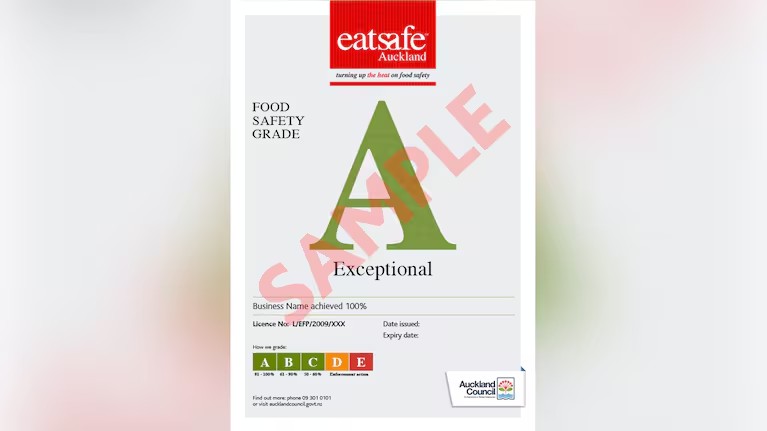
Auckland restaurants, bars, cafes and takeaways could no longer be required by local bylaw to display food grade certificates after a council review found the city's Food Safety Information Bylaw may no longer be fit for purpose.
1News, carrying Local Democracy Reporting, reported on 28 July that the bylaw expires next April. If it is allowed to lapse, businesses would not be compelled under that local rule to display A to E food grade certificates for customers. The review cited in the report found that the national Food Act framework already provides an effective food safety system, meaning the local bylaw may no longer be necessary.
For Auckland diners, the visible grade has become a familiar shortcut. A certificate on the window tells customers that the business has been inspected and gives them a quick signal before they order. Removing the compulsory display requirement would not remove food safety law, and it would not stop customers from checking grades online. But it would change the moment of decision from the shopfront to the council website, which many people will not check when they are choosing lunch or dinner.
Councillor Josephine Bartley told 1News the bylaw had served its purpose but was no longer required, and said drafting a new bylaw would be costly. She also said businesses would benefit from displaying their grades voluntarily, especially if they held an A grade. That argument has merit: good operators have every incentive to show a strong score, and a business that hides a poor grade may invite more questions than it avoids.
The other side is consumer clarity. Voluntary display creates inconsistency. Some businesses will keep certificates visible. Others may rely on online records. Customers may then have to distinguish between a missing certificate because display is no longer required and a missing certificate because a business would rather not draw attention to its result. A simple public-facing system can lose power if the signal is no longer universal.
The enforcement history also matters. 1News reported that 33 businesses have been prosecuted since 2019, with the highest court-imposed fine reaching $45,000 and council cost recovery exceeding $450,000. Those figures suggest the food safety system is not purely theoretical. Inspections, grades and enforcement have real consequences for operators and customers.
Food businesses also have a practical interest in certainty. If the bylaw lapses, council communication needs to be clear so restaurants know what must still be displayed, what can be displayed voluntarily, and how online records will be maintained. Confusion would not help responsible operators or consumers.
The change would also arrive in a difficult period for hospitality. Consumers are watching prices closely, and operators are trying to manage wages, rent, ingredients and debt. A clear grading signal can help trusted venues convert caution into a sale, while weak communication can make diners more hesitant. That is why the council's decision should be explained as a consumer-information change, not merely as a technical bylaw expiry.
For Kiwi News Desk readers outside Auckland, the story is still relevant because local food grading systems are part of how councils translate national food law into everyday consumer information. The national Food Act sets the legal framework, but local visibility shapes customer behaviour. Auckland's decision will show whether councils believe online transparency is enough, or whether a certificate in the window still does public work that a database cannot easily replace.